The engineering behind Matic Serene's smoother sound
How we redesigned Matic's vacuum stack to make an already quiet robot sound even better.
By The Matic Team • October 27, 2026
We’ve always believed that a cleaning robot should make life easier, not demand your attention.
At Matic, we think about sound as carefully as we think about navigation, cleaning performance, and everything else that makes a robot feel at home. After all, Matic doesn't just run when you turn it on. It cleans while you're taking calls, watching movies, putting the kids to bed, or going about your day.
And when a robot is working around you every day, how it sounds matters just as much as how loud it is.
That's the thinking behind Matic Serene, our latest advancement in acoustic engineering. By redesigning the vacuum stack, we've created a softer, smoother sound without compromising suction or cleaning performance.
Here's how it works.
Quiet is more than a decibel number
When we talk about how quiet something is, we usually reach for decibels (dB). They're a useful starting point, but they don't tell the whole story.
Think about the difference between a gently humming fan and a mosquito buzzing near your ear. Even at similar measured sound levels, one might fade comfortably into the background while the other is impossible to ignore.
That's because our ears respond to more than volume. They respond to frequency, pitch, and tone.
A vacuum produces a combination of sounds. There's the broad, steady rush of moving air, which we hear as a whoosh. And then there are narrower, higher-pitched tones that can stand out above that background.
To understand how Matic sounds, our engineers look beyond a single decibel measurement. We analyze the entire frequency spectrum, identifying which sounds blend naturally together and which draw attention to themselves.
For Serene, we focused on a sound common to vacuum cleaners: the tonal hum or whine produced by a spinning fan. It's a natural part of how vacuum fans work, although how noticeable it is varies from one design to another.
The science behind the sound
Inside Matic, a powerful vacuum motor drives a nine-bladed fan that can spin at up to 58,000 revolutions per minute. As the fan spins, each blade creates a tiny pressure pulse as it passes through the air. Thousands of these pulses occur every second, combining into a continuous, high-frequency sound.
Engineers call this the blade-pass tone.
In Matic, this tone falls around 5 to 7 kHz in Standard mode, rising toward 9 kHz on Deep. It's a relatively narrow band of high-frequency sound that can stand out against the broader rush of air.
It's not necessarily the loudest part of the vacuum. But because it's concentrated at a particular pitch, our ears can pick it out more easily. So rather than simply trying to lower the overall volume, we set out to make that tone less prominent.
Rethinking the vacuum stack
To make the fan's high-frequency tone less noticeable, we turned our attention to Matic's vacuum stack: the assembly that houses the motor and directs airflow through the robot.
Our engineers redesigned the stack to better manage how sound travels through the system. Beyond reducing the prominence of the blade-pass tone, we also worked to reduce airflow noise and the sound transmitted through the motor assembly.
The aim wasn't simply to make the vacuum quieter, but to make its sound smoother and less intrusive. Same motor, same suction. A softer, smoother sound.
The difference you can hear
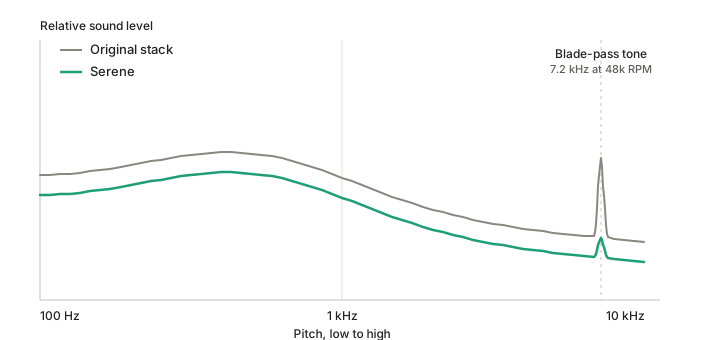
Our acoustic measurements show that the redesigned stack reduces the prominent high-frequency whine by approximately 10–15 dB.
The overall sound level has also decreased from 55 dB to 52 dB. Because decibels are measured on a logarithmic scale, that 3 dB difference represents roughly a 50% reduction in acoustic energy, corresponding to approximately 20% less perceived loudness as a general rule of thumb.
But the improvement goes beyond overall volume. By reducing both the high-frequency tone and the surrounding noise, we've changed the character of Matic's sound across the frequency spectrum.
Previously, the fan's characteristic tone formed a distinct peak above the surrounding frequencies. With Serene, that peak is substantially flatter, allowing the sound to blend more naturally into the broader rush of air. Instead of a prominent high-pitched note, you hear more of a soft, even whoosh.
It's a distinction that matters when a robot is cleaning beside you, rather than interrupting what you're doing.
Every Matic gets its own sound check
Engineering a smoother sound is one challenge. Making sure that sound is consistently reproduced across thousands of robots is another. As Matic grew, we needed a more scalable way to measure sound consistently across production. That’s why our engineers designed and built our own acoustic testing enclosures.
Each enclosure features double-wall construction with insulation and acoustic foam inside, creating a controlled, hemi-anechoic testing environment to minimize sound reflections that might interfere with measurements. Microphones capture sound from multiple directions, giving us a more complete picture of how each robot sounds.
Every Matic undergoes acoustic testing of all of its moving components, including the vacuum motor, drive motors, brush, pump, and mop system.
The sound of something better
Our goal has always been to make a robot that fits naturally into everyday life. One that cleans thoroughly, navigates intelligently, and works so effortlessly that you can almost forget it's there.
Serene is another step toward that goal.
Not just quieter by the numbers, but softer, smoother, and more comfortable to live with.
That's what quiet by design means to us.